White-label subcontracting is an arrangement in which one firm delivers part of a client engagement on behalf of another, entirely under the second firm’s brand. The client contracts with, pays and speaks to the firm it hired, while the subcontractor does the work behind it. Done properly, the client never needs to know that the subcontractor exists, and nothing about the relationship it chose has changed.
For implementation partners, agencies and software vendors, integration is where this model earns its keep. A client buys a Salesforce rollout, a NetSuite migration or a new commerce platform, and then comes the sentence that decides whether the project lands: “and it has to stay in sync with the ERP, the billing system and the warehouse.” That work sits next to the partner’s practice but is technically unlike it, and it is almost always on the critical path. This guide explains how white-label subcontracting works in practice for integration engineering, what belongs in writing, how the work is usually priced, and which failure points are worth designing out before the first engineer logs in.
Why partners subcontract integration in particular
The firms that subcontract integration are rarely short of good people. What they lack is the right people at the right moment, because integration demand behaves quite differently from platform work. It is uneven from one quarter to the next, so a firm that hires for the peak pays for the trough. It is broad, so that one engagement calls for SAP IDocs, the next for a mainframe message queue and the one after for a payments webhook design, and very few in-house teams cover that range in any depth. It is also unforgiving. A badly designed synchronization can corrupt data quietly for weeks before anyone notices, which is why experience of how integrations fail matters more than familiarity with any particular tool.
Above all, integration is not what the partner sells. Clients hired the firm for the platform, and they tend to assume the integrations will simply work. White-label subcontracting allows the partner to accept the whole project, keep both the relationship and the margin, and put specialists on its riskiest part without building a practice it only needs some of the time.
White-label subcontracting vs. other ways to add capacity
| Model | Who the client sees | Who owns delivery | Best when |
|---|---|---|---|
| White-label subcontracting | Only you | You, with a specialist underneath | You want one accountable firm in front of the client |
| Named subcontractor | You plus a named specialist | Shared, defined by the SOW | The client values a dedicated firm on the hard part |
| Staff augmentation | Individuals inside your team | You, entirely | You have the leadership and only lack hands |
| Referral to another firm | The other firm | The other firm | You do not want the work, and accept losing that part of the account |
These models are not mutually exclusive. Many partners use the same subcontractor invisibly on one account and as a named specialist on the next, depending on what strengthens their position with that particular client.
How it works, step by step
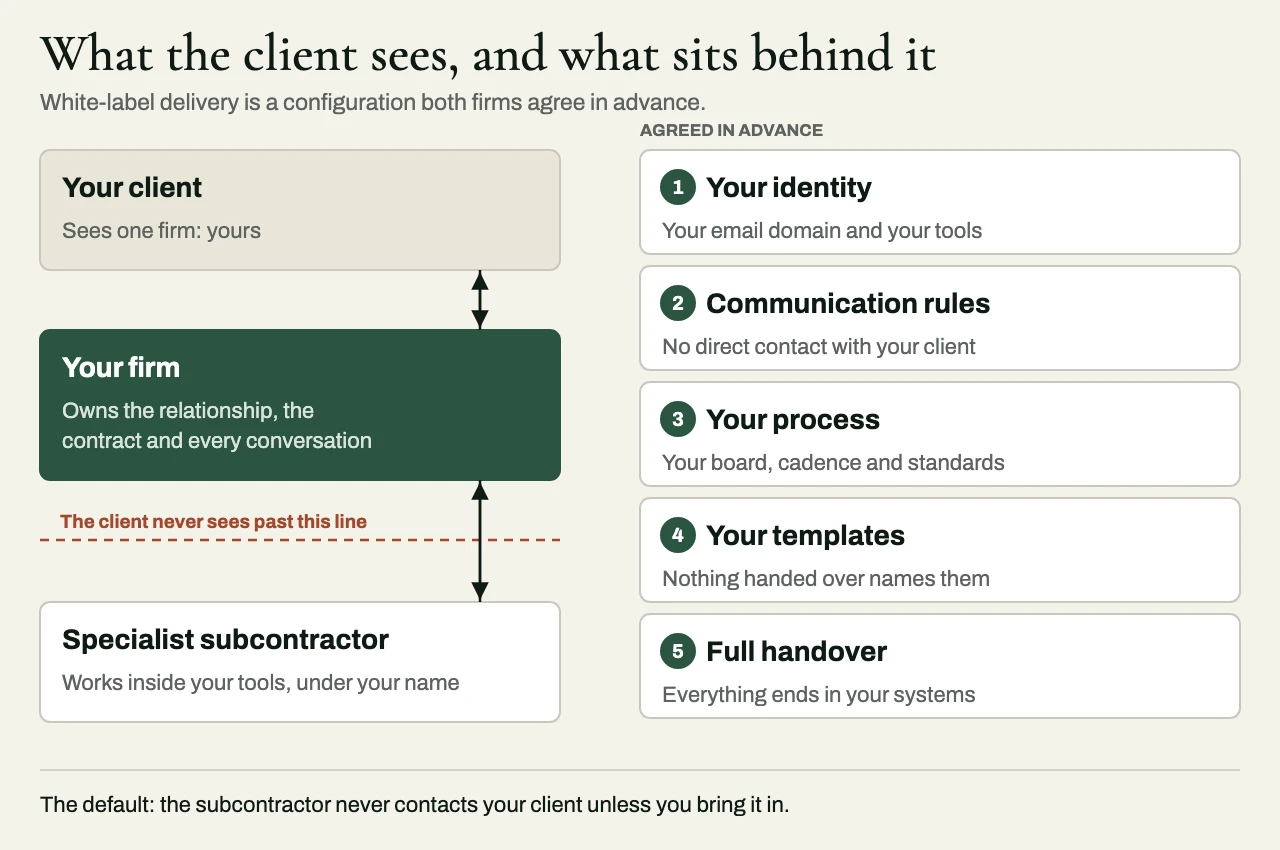
White-label delivery rarely fails on engineering. It fails in the details: an engineer replying from the wrong email address, a document with the wrong footer, or a status call on which someone introduces themselves as “the subcontractor”. The arrangement is best treated as a configuration that both firms agree in advance, rather than an intention everyone hopes to honor.
1. Set up the subcontractor under your identity
The partner provisions accounts on its own email domain and in its own tools, including the issue tracker, repositories, chat workspace and document system. The subcontractor names the engineers who will hold those accounts, and access is scoped to what the engagement actually requires. A capable subcontractor should be productive inside the partner’s tools within days, and if it cannot be, that tells you something useful early.
2. Write down the communication rules
Agree who speaks to the client, on what cadence and in what format, and what happens when something breaks at an inconvenient hour. The default should be that the subcontractor never contacts your client directly unless you deliberately bring it into a conversation. Once a direct channel exists, clients use it, and control of scope and expectations quietly moves away from the firm that owns the relationship.
3. Run your process, not theirs
The work should follow the partner’s board, sprint cadence, branching and review standards, and definition of done. Status should arrive in the form the partner reports upward, so that nobody spends the hour before a client call rewriting someone else’s update into their own language.
4. Deliver in your templates
Code, documentation, architecture diagrams, runbooks and test evidence should carry the partner’s identity and live in the partner’s systems. Nothing handed to the client should name the subcontractor.
5. Hand over so nothing stays with the subcontractor
At the end of the engagement, everything should live in the partner’s systems and the client’s: source code, configuration, credentials, documentation, and a walkthrough for whoever maintains the work next. If ongoing monitoring and support are needed, they belong in a separate managed agreement, still delivered under the partner’s brand.
What to put in writing
The contract stack for white-label subcontracting is short, but each document has a specific job, and a subcontractor that insists on its own paper for all of it is giving you an early warning. The cleanest arrangements run on the partner’s terms.
The NDA should cover client identity, data, architecture and commercial terms. White-label work means the subcontractor learns things about your client that you would never want carried into another engagement, so the confidentiality obligations deserve real attention.
The MSA and subcontract agreement set out the partner’s master terms and flow down whatever client obligations apply to the work, such as security, data handling, residency, audit rights and background checks. A statement of work for each engagement then defines scope, acceptance criteria and deliverables, and records which white-label mode applies to that engagement: invisible, extended team or named specialist.
Non-solicitation should run in both directions. A good non-solicit protects what each party actually values in the relationship. For the partner, that is usually its clients, its staff and the platform work it sells. For the subcontractor, it is usually the engineers it has hired, trained and built its delivery around. The clause should give both parties the same protection, with a clear scope and a reasonable duration. One-sided clauses tend to be resented or quietly ignored, and neither outcome helps the engagement.
Intellectual property should follow the partner’s agreement with its client, which normally means the deliverables belong to the partner or the client. Any pre-existing libraries the subcontractor uses should be identified at the outset and licensed, so that nothing left behind creates a dependency. Finally, ask for current insurance certificates and negotiate liability and indemnity in the subcontract as you would any other provision.
This is practical guidance, not legal advice. Have your own counsel review the agreements.
How white-label integration work is priced
Three commercial shapes cover most situations. A scoped work package, priced as a fixed fee against a defined integration with clear acceptance criteria, is also the sensible way to test a new subcontractor before trusting it with a larger engagement. An embedded bench, with named engineers inside the partner’s team on a monthly commitment, suits programs where scope will move. Managed integration support covers monitoring, alerting and fixes after go-live under agreed response targets.
Where the work is discovery-heavy, as most rescues are, it is better to begin with a bounded deep dive and price the delivery once the situation is understood. Fixed-pricing an unknown does not remove the risk; it converts it into contingency, and someone pays for that contingency either way.
Seven places white-label subcontracting goes wrong
The identity leaks. A personal email address, a document footer or a calendar invitation from the wrong domain may seem trivial, but each small leak erodes the partner’s credibility with the client.
The subcontractor talks to the client. It usually happens with the best of intentions, and it is still a mistake. Once a direct channel exists the client will use it, and the partner loses control of scope and expectations.
The subcontractor also sells your platform. A subcontractor with its own Salesforce, NetSuite or commerce practice is a competitor being trained inside your account. It is far safer to work with firms whose business is the integration layer alone.
Nobody owns the 2 a.m. incident. Integration failures tend to surface at night and at month-end. The escalation path needs to be agreed before go-live, not improvised during the first outage.
Scope lives in two documents. The client SOW and the subcontract SOW drift apart over time unless acceptance criteria live in a single source that both documents reference.
Knowledge stays with the subcontractor. If the mappings, credentials and failure history exist only in the subcontractor’s heads, the partner has bought a dependency rather than a deliverable.
The first engagement is too big. Starting with one integration or one deep dive is the cheapest way to learn whether a firm behaves the way its website says it does.
Checklist: vetting a white-label integration subcontractor
- Do they run a platform practice that competes with yours?
- Will they sign your NDA, MSA and subcontract, or only theirs?
- Will they work entirely inside your domain and tools?
- Is “never contact the client directly” their default, in writing?
- Is the non-solicit mutual and fair to both sides, and does it protect what each of you actually values?
- Who owns IP, and how are their pre-existing libraries licensed?
- Can they show integration depth across the systems your clients actually run, including ERP, CRM, billing and legacy platforms?
- What is their incident response, and who is on call?
- What does handover include, and what stays behind with them?
- Will they start small, with a fixed-scope package or a single deep dive?
Related reading
- How to scope integration work in a statement of work
- Software project rescue: warning signs and what a real rescue looks like
How we approach it at eProxim
eProxim has engineered integrations underneath other firms’ client relationships since 1997. We do not run a platform implementation practice, so there is nothing in your account for us to want. We work on your paper, under your domain and inside your tools, deliver in your templates, and never contact your client unless you put us in the conversation. You choose the mode for each engagement: invisible, part of your extended team, or introduced as your named integration specialist.
The operating rules are set out on our white-label delivery page, and the contract, IP and pricing questions partners ask first are answered in the partner FAQ. If you have integration work you would rather not hire for, start a partner conversation.