The useful applications of AI in most businesses are not conversations. They are process-bound work: reading a document and extracting what matters, deciding which path a case should take, reconciling two records that disagree, or drafting a response that a person then approves.
An AI agent that does this work has to act on real systems, such as the ERP, the CRM and the ticketing platform, and that is the point at which AI agent guardrails stop being a philosophical topic and become an engineering requirement. An agent that can act needs boundaries it cannot reason its way past, and it needs a record of everything it did.
A worker, not a chat window
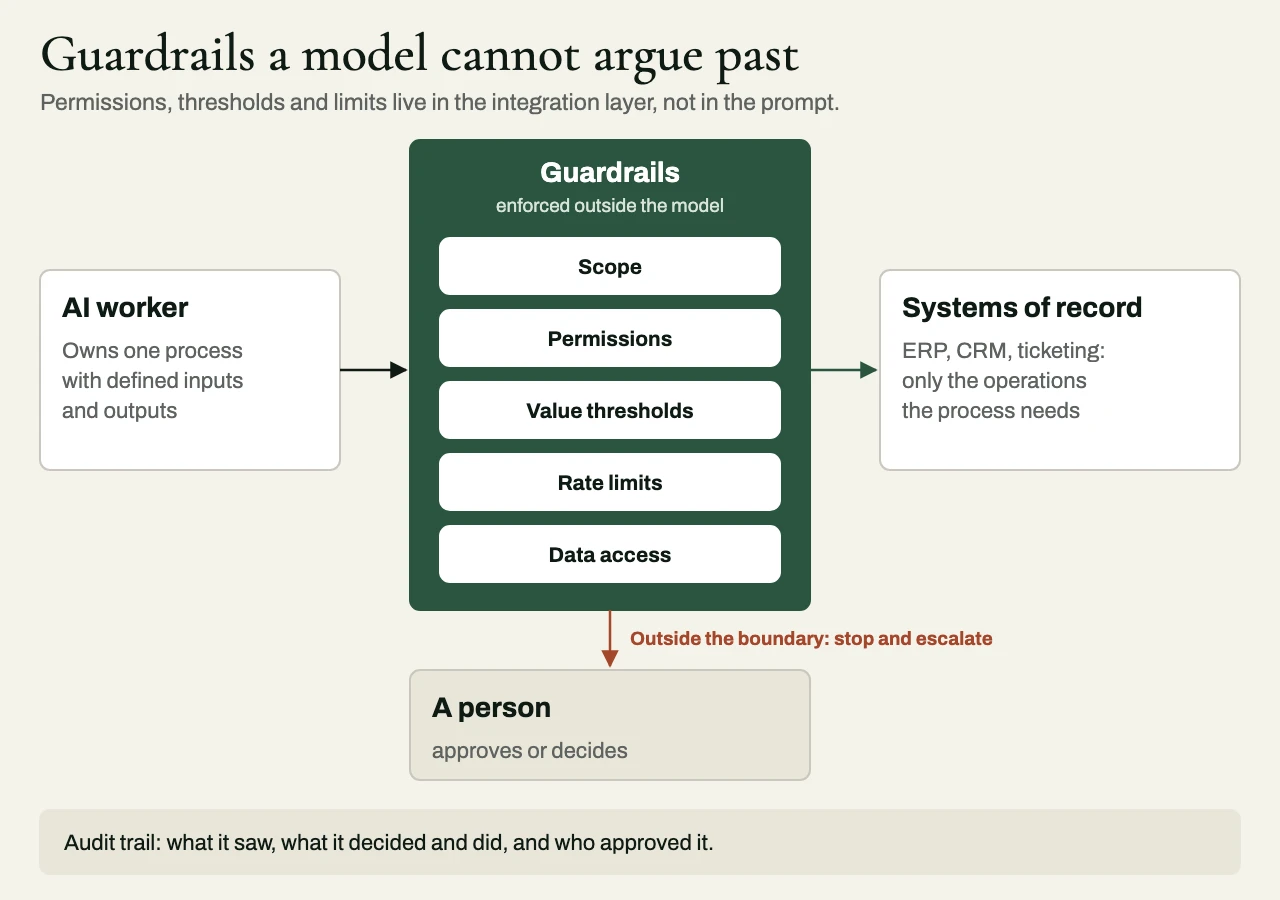
The first guardrail is a design choice, which is to build a bounded process owner rather than a general-purpose assistant with broad access. A bounded worker owns one process, with defined inputs, outputs and conditions for success. It is given only the tools and data that the process requires, and it knows both what a correct outcome looks like and what it must hand to a person.
A general-purpose agent with vague access to everything is, by contrast, harder to test and harder to secure, and it is impossible to explain to an auditor. I would argue that most of the risk people associate with AI agents is really the risk of this second design.
The guardrails that matter
| Guardrail | What it constrains | Example |
|---|---|---|
| Scope | Which process and which records the worker handles | Only supplier invoices for one entity |
| Permissions | Which systems and operations it can use | Can create a draft credit note, cannot post it |
| Value thresholds | The size of action it can take alone | Auto-approves matches within a set tolerance; escalates larger differences |
| Rate limits | How much it can do in a period | A cap on actions per hour, so a fault cannot cascade |
| Data access | What it can read, and what leaves the boundary | No personal data sent outside approved services |
| Escalation rules | When it must stop and hand off | Unrecognized document types, conflicting records, low confidence |
Two principles apply to all of them. The first is that guardrails must be enforced outside the model. Permissions, thresholds and rate limits belong in the integration layer and in the systems’ own access controls, not in a prompt, because a prompt can be argued with and an API permission cannot. The second is that the worker should fail closed: anything that falls outside its boundary stops and escalates rather than improvising.
Human checkpoints, calibrated to risk
Not every action needs approval, and requiring approval for everything defeats the purpose of automating the work at all. Autonomy should instead be calibrated to consequence. Where an action has little consequence and is easily reversed, the worker can act and record what it did. Where the consequence is moderate, the worker prepares the decision and a person approves it. Where the consequence is high or the action cannot be undone, a person decides, and the worker’s role is to assemble the evidence.
That calibration should be written down and agreed with whoever carries the risk, usually finance, operations or compliance, before anything is built. It is far easier to win the confidence of a risk function by showing it the boundaries in advance than by explaining them after an incident.
Audit trails
Every action, input, decision and output should be recorded and queryable: what the worker saw, what it decided and why, what it did, and who approved it, if anyone did. When an auditor, a regulator or a finance lead asks what happened to a particular record on a particular date, there has to be an answer. An automation that cannot be inspected is not a capability. It is an unrecorded decision, running continuously.
Evaluate before autonomy widens
Guardrails are only as good as the evidence that the worker behaves well within them, and that evidence has to be gathered before autonomy is extended. A disciplined sequence looks like this:
- Evaluate against held-back cases with known correct outcomes, measuring accuracy and escalation rate.
- Start with a person approving every action, and compare the worker’s proposals with what the person decides.
- Loosen gradually as the record justifies it, one category of action at a time.
- Keep monitoring after go-live, watching accuracy, escalation rate, exceptions and drift as the inputs change.
Choosing a first process
The best first candidates are processes that are frequent, governed by rules, currently manual and measurably expensive, which in practice tends to mean exception handling, reconciliation, case triage, document processing and data enrichment. Processes that are none of those things make poor first candidates, however interesting they may sound, because there is neither enough volume to learn from nor a clear cost against which to measure success.
Illustrative scenario: an invoice exception worker
This scenario is a composite. It is representative of the AI automation work we do, but it does not describe a specific client, and nothing in it is a reported result.
A distributor’s accounts payable team spends much of its week on invoices that fail three-way matching against purchase orders and receipts. Most of these exceptions follow a handful of patterns: price differences within tolerance, partial receipts, freight lines and duplicated invoices.
A worker is built to own that exception queue. It reads each failed invoice, retrieves the purchase order and receipt through the existing ERP integration, classifies the exception and proposes a resolution. It may clear price differences within an agreed tolerance and flag likely duplicates, while everything else is prepared for a person to approve. It cannot post payments or edit supplier master data, because those permissions simply do not exist for its integration account, and every proposal, decision and approval is logged.
The worker runs in approval-only mode at first. Categories in which its proposals consistently match the team’s decisions are then allowed to proceed automatically, one at a time.
A good outcome is one in which the team spends its time on the genuinely unusual exceptions, finance can see exactly what the worker did on any given day, and the risk function approved the design before it ever touched production.
Related reading
- Integration reconciliation reports: proving two systems agree
- Idempotent webhooks: duplicates, retries and out-of-order events
Working with eProxim
eProxim builds AI workers that run process-bound workflows with bounded scope, explicit guardrails, human checkpoints and full audit trails. They act through the same APIs, middleware and event pipelines we build for integration work, so they operate on real systems of record rather than on exports, and they can be delivered under a partner’s brand.
Have a process your client repeats a thousand times a month? See our AI automation services, or start a partner conversation.