A Zuora Salesforce integration connects the place where subscriptions are sold to the place where they’re billed. Sales teams quote, negotiate and close in Salesforce, and Zuora turns the signed deal into a subscription, generates the invoices, collects the payments and keeps the record of what each customer owes. When the connection works, a rep can see a customer’s current subscription, open invoices and payment status without leaving the account page, and finance can trust that what was sold is what’s being billed. When it doesn’t, the two systems drift apart quietly – and the drift usually starts with the first change to a contract after the original sale.
That first change is what this article is about. The initial quote-to-subscription flow is well understood, and it’s rarely the cause of trouble. Amendments are where the design decisions show: upgrades, downgrades, renewals and cancellations, each of which has to be expressed in both systems in a way that leaves them agreeing with each other. I’ll compare the two broad design patterns (Zuora-led quoting and Salesforce CPQ-led quoting), and then cover account and subscription ownership, amendments, usage, invoice and payment visibility, and reconciliation. Which firm should own which part of a Zuora program is a separate question, and I’ve written about it in our article on Zuora implementation partners and integration partners.
Two design patterns
There are two common ways to connect the systems, and the choice between them shapes almost everything that comes after it.
In a Zuora-led design, quoting happens in Salesforce using Zuora CPQ – Zuora’s own quoting product, which runs inside Salesforce as a managed package (you’ll still see it in the org as the Zuora Quotes package). Reps build quotes from the Zuora product catalog, which is synchronized into Salesforce, and when a quote is accepted, it goes to Zuora to create or amend the subscription. Billing data then flows back into Salesforce through Zuora’s sync for Salesforce (Zuora 360, Zuora 360+ or the newer Zuora Connector for Salesforce CRM), which copies accounts, subscriptions, invoices, payments and related records into Salesforce objects. Catalog sync depends on the Zuora CPQ package being installed, which is one reason many Zuora-led orgs carry it even where they do very little quoting. What makes this pattern attractive is that the catalog, the pricing logic and the subscription model are Zuora’s own from end to end, so the quote is written in the same terms as the subscription it creates.
In a CPQ-led design, quoting happens in Salesforce CPQ or another Salesforce-native quoting product, with a product catalog and pricing rules maintained in Salesforce. Once a quote is accepted, an integration translates the resulting order or contract into Zuora subscription actions, either through Zuora’s own billing connector for Salesforce CPQ or through a custom integration. Billing data may still come back to Salesforce through Zuora’s CRM sync or a custom sync. Organizations pick this pattern when they’ve already invested heavily in Salesforce CPQ, when their configuration and approval rules are complicated enough that they want them all in one place, or when the same quoting process also sells things Zuora doesn’t bill.
| Consideration | Zuora-led (Zuora CPQ) | CPQ-led (Salesforce CPQ or similar) |
|---|---|---|
| Where the catalog lives | Zuora, synced into Salesforce | Salesforce, mapped to Zuora |
| Where pricing logic runs | Zuora’s charge models | Salesforce price rules, translated afterward |
| Amendment handling | Native amendment and renewal quotes against the Zuora subscription | The integration has to translate CPQ amendments into Zuora actions |
| Main integration risk | Keeping the synced catalog and data current | Mapping between two subscription models |
| Typical fit | The billing model is the center of gravity | Complex configuration and approvals already live in CPQ |
Neither pattern is right in the abstract. My own view is that the CPQ-led pattern gets chosen more often than it should – usually because CPQ is already there – and that the cost of translating between two subscription models is underestimated at the start. If the business mainly sells subscriptions, and its pricing complexity lives in charge models more than in configuration rules, the Zuora-led pattern takes away a whole class of mapping problems.
Who owns the account and the subscription
Before anyone builds a flow, the design has to say which system is the system of record for each object, and the answer is rarely as simple as “Salesforce owns customers and Zuora owns billing”.
The Salesforce account and the Zuora billing account are two different things. One Salesforce account may correspond to several Zuora billing accounts – for example, where a customer pays separately for different subsidiaries, currencies or business units – and corporate hierarchies may be modeled differently in each system. So the design needs an explicit rule for when a new billing account gets created, which fields Salesforce owns (typically the customer name, ownership and segmentation), and which fields Zuora owns (bill-to and sold-to contacts, payment method, currency, payment terms and invoice delivery preferences, unless someone deliberately decides otherwise).
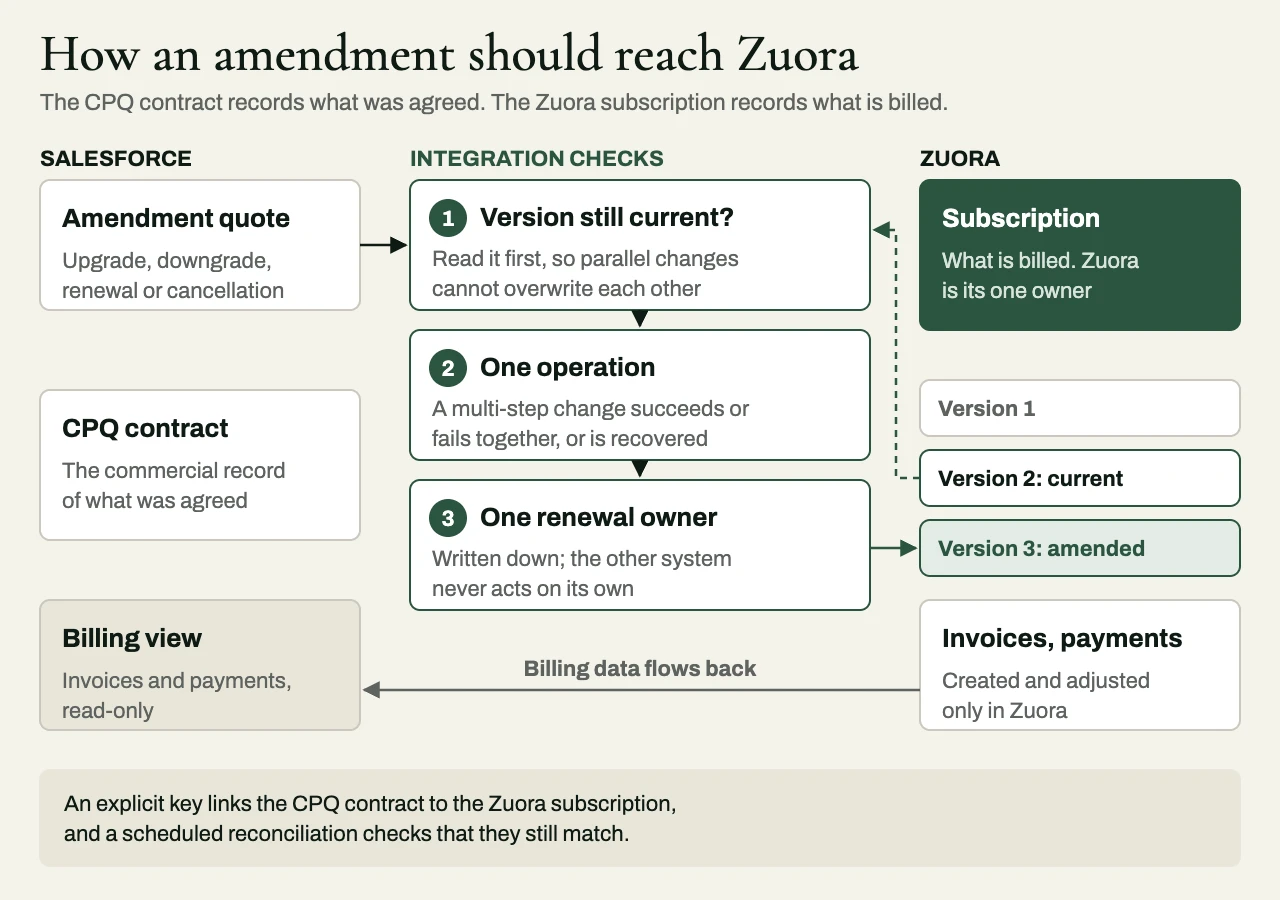
The subscription itself should have one owner, and that owner should almost always be Zuora. It’s the system that bills against it, and the subscription’s version history in Zuora is what finance and the auditors will rely on. In a Zuora-led design, this follows naturally. In a CPQ-led design, it’s the single most important decision in the project, because Salesforce CPQ keeps its own contract and subscription records, and if both systems are allowed to believe they hold the authoritative version, they’ll disagree within weeks. The cleanest arrangement treats the CPQ contract as the commercial record of what was agreed and the Zuora subscription as the operational record of what’s billed, with an explicit key linking the two and a reconciliation that checks they still match.
Amendments are the hard part
A new subscription is a single creation event. An amendment is a change to something that already exists, in two systems, each with its own idea of dates, terms and versions. Every amendment raises the same questions – which version of the subscription is being changed, from what effective date, how the change is prorated, whether it affects the term, and what happens to the invoice already issued for the current period. Both systems have to answer those questions the same way, and in a CPQ-led design, the integration has to translate between their two sets of answers.
The table below shows how each common type of amendment typically flows, and where each one tends to go wrong.
| Amendment | Starts in Salesforce as | What happens in Zuora | Where it goes wrong |
|---|---|---|---|
| Upgrade (add product or increase quantity) | An amendment quote against the existing contract or subscription | A new or updated charge from an effective date, prorated for the partial period | Effective dates differ between the systems; proration is calculated twice, or not at all |
| Downgrade (remove product or reduce quantity) | An amendment quote, often needing approval | The charge ends, or the quantity drops, from an effective date; a credit may be generated, depending on billing settings | Credits get issued that the business didn’t intend, or don’t get issued when it did |
| Price change | An amendment or renewal quote with the new price | The charge is updated or replaced from an effective date | A discount held in Salesforce has no equivalent in Zuora |
| Renewal | A renewal quote, or automatic renewal | The term is renewed, possibly with changed products or prices | Auto-renewal in Zuora and a renewal opportunity in Salesforce both act, or neither one does |
| Co-termination | New products added to line up with an existing term end | The added charges are prorated to the existing term end date | Salesforce calculates a different term or price for the stub period |
| Cancellation | A cancellation quote, or a request raised through a case | The subscription is canceled from an effective date, with any credit as configured | The cancellation is recorded in only one system, and billing carries on |
| Mid-term restructuring | Several changes at once, sometimes across subscriptions | Multiple amendment actions that have to succeed or fail together | A partial success leaves Zuora in a state Salesforce never quoted |
Three design principles make amendments manageable. First, every amendment should reference a specific version of the subscription, so two changes prepared in parallel can’t silently overwrite each other. Zuora versions a subscription each time it’s amended, and the integration should check that the version it’s about to amend is still the current one. Second, a multi-step amendment should go in as a single operation where the platform supports it, or else be wrapped in logic that can detect a partial failure and recover from it – a half-applied restructuring is worse than one that was rejected outright. Third, renewals need one owner. Whether Zuora renews automatically and Salesforce reflects it, or Salesforce drives a renewal quote that Zuora applies, the rule should be written down, and the other system should never act on its own.
Since amendments carry most of the risk, they should get most of the testing too.
Usage
Usage data rarely belongs in Salesforce as raw records. Metered events come from product systems in volumes a CRM was never designed to store, and they should flow straight into Zuora for rating and billing. What Salesforce users need is a summary: consumption against commitment for the current period, the trend over recent periods, and a warning when a customer is heading toward an overage or isn’t using what they bought. That summary is useful for account management and renewals, and it can be synchronized at a sensible frequency, either from Zuora or from the usage pipeline. The engineering of the usage pipeline itself (deduplication and late-arriving events included) is covered in the implementation versus integration partner article.
Invoice and payment visibility in Salesforce
Much of the day-to-day value of a Zuora Salesforce integration comes from showing billing data where account teams already work. A rep getting ready for a renewal call should see open invoices, overdue balances and recent payment failures before picking up the phone. A support agent handling a billing question should be able to see the very invoice the customer is asking about.
That visibility should be read-only in Salesforce. Invoices, credit memos, payments and refunds are created and adjusted in Zuora, under the billing team’s controls, and letting people edit them in two places invites the kind of discrepancy no sync can fix. The design also needs to be honest about latency. Whether data arrives in near real time or on a schedule, users should know how current it is, and a “last synchronized” timestamp on the relevant records saves a surprising number of support conversations. It’s also worth asking what users really need – a summary of balances and recent invoices is often enough, and it’s much easier to keep accurate than every last invoice line.
Reconciliation
Two systems that are supposed to agree should be shown to agree, on a schedule, by a report – it isn’t something anyone should simply assume. For a Zuora Salesforce integration, the checks that matter most are easy to state. Every closed-won opportunity or accepted quote should correspond to a subscription or amendment in Zuora, and every subscription change in Zuora should trace back to a commercial record in Salesforce. Contract value, recurring revenue or quantity per account should match between the commercial record and the subscription, within whatever tolerance for timing has been agreed. Amendments that were submitted but haven’t been applied yet should show up on a pending list, along with their age. And the account mappings should be complete, with no Zuora billing account missing a Salesforce parent, and no active customer missing a billing account.
These checks catch the drift that amendments create before finance runs into it at month-end. We describe how to structure reports like these, and why they should be computed by a program instead of eyeballed, in Integration reconciliation reports.
A client example. One of our clients, a SaaS company with roughly 3,000 business customers, sold in Salesforce and billed in Zuora. After a year of add-ons, seat reductions and renewals, the account managers and billing operations were looking at different counts of active subscriptions. No API was broken. The connector treated every closed-won quote as a new subscription action, even when the quote was an amendment to an existing subscription, and a separate retry job sometimes replayed a renewal request after a timeout, because it had no way of knowing whether Zuora had committed the first one.
We reconciled by Zuora subscription ID and subscription version, since account names and opportunity numbers matched too loosely to trust. We built a lifecycle ledger that tied each Salesforce quote or order action to a Zuora subscription and its effective-dated amendment, with separate handling for new subscriptions, add-ons, renewals, cancellations and backdated changes. Before sending any change, the integration now read the subscription’s current state and stored a unique source action ID, a request fingerprint and the outcome, and an ambiguous timeout triggered a state lookup before any retry. The cleanup turned up 126 suspect subscriptions: 38 duplicate renewal attempts, 51 amendments misclassified as new subscriptions, and the rest timing or mapping differences. Billing decided the corrective actions and approved every credit and rebill. After two billing cycles, the daily exception queue had fallen from more than 100 items to fewer than 10. Syncing more often fixes none of this. What fixed it was treating a renewal and an amendment as distinct business operations, and making every command safe to retry.
Related reading
- Zuora implementation partner vs integration partner
- Integration reconciliation reports: proving two systems agree
- NetSuite Salesforce integration: keeping CRM and ERP in agreement
How we approach it at eProxim
eProxim doesn’t run a Zuora or Salesforce implementation practice. We build the integration layer between the two, working alongside the partners and internal teams who own the platform configuration, and we’ve been engineering integrations across billing, payments and financial systems since 1997. On Zuora Salesforce work, that usually means designing the ownership rules for accounts and subscriptions, building and testing the amendment flows that cause most of the trouble, and putting reconciliation in place so both systems can be shown to agree.
Our Zuora page explains how we work on Zuora programs. If your Salesforce and Zuora records have started to disagree, or you’re planning the connection and want the amendments designed properly from the start, contact us.