ServiceNow IT Financial Management (ITFM) brings IT spending into the same platform where IT services, assets and demand already live. Once the spending is there, costs can be allocated to the services that consume them, compared against budgets, and shown back or charged back to the business.
The configuration inside ServiceNow is the visible part of an ITFM rollout, but it’s seldom the difficult part. The harder work is getting accurate, timely financial data into the platform – from finance, HR, procurement and the cloud providers – and, sometimes, sending allocations back out again. Even then, the difficulty is seldom about connectivity. It lies in making sure that the data means the same thing in every system it passes through. A $100,000 expense in SAP might be a capital purchase, a recurring service, or an accrual that will be reversed next month, and by the time it reaches ServiceNow, that accounting context still has to be intact.
This article covers the data sources ITFM depends on, the integration patterns that are available, and the design decisions that make or break an implementation. It also describes an enterprise integration engagement that eProxim delivered.
ServiceNow module names and packaging vary by release and license. Product-specific capabilities should be checked against the target instance.
Why Integration Is the Hard Part of ITFM
ITFM doesn’t create financial data of its own – it reorganizes data that already exists somewhere else. Every number on a cost transparency dashboard started life in another system – as a general ledger journal, a payroll run, a cloud bill or a supplier invoice. When those feeds are incomplete, late, duplicated or mapped inconsistently, the allocations that come out of them are wrong in ways that can be surprisingly hard to spot, and the first person to notice is usually the finance controller, at month-end, in front of the CIO.
So an ITFM implementation has to be able to answer one fundamental question:
Does the total in ServiceNow agree with the total in the ledger?
The question sounds simple, until multiple ERPs, currencies, fiscal calendars, acquisitions, intercompany transactions, shared infrastructure and accounting adjustments come into the picture. At that point, the integration architecture has turned into a problem of financial control, and it should be designed as one.
The Data ITFM Needs, and Where It Comes From
| Data | Typical source | Usual frequency | Main complication |
|---|---|---|---|
| General ledger actuals | SAP, Oracle, NetSuite, Dynamics | Monthly, after close | Late journals and reclassifications |
| Budgets and forecasts | ERP, Anaplan, planning systems | Planning cycle | Different granularity of accounts and cost centers |
| Labor costs | Workday, payroll, timesheets | Payroll cycle | Confidentiality and allocation |
| Cloud spending | AWS, Azure, Google Cloud | Daily or monthly | Credits, discounts and amortization |
| Procurement | Coupa, ERP, accounts payable | Daily or monthly | Duplicate costs and multi-year contracts |
| Assets and licenses | ServiceNow CMDB, SAM, asset systems | Continuous | Incomplete service relationships |
| Organizational hierarchy | ERP, HR | On change | Reorganizations and historical reporting |
Each of these feeds has its own accounting meaning, its own refresh requirements and its own data quality problems. If you treat them all as simple API integrations, you’ll build a system that works beautifully – right up until finance tries to close the books.
From the Field: Enterprise ITFM Integration
Integrating eight enterprise systems to support IT cost transparency
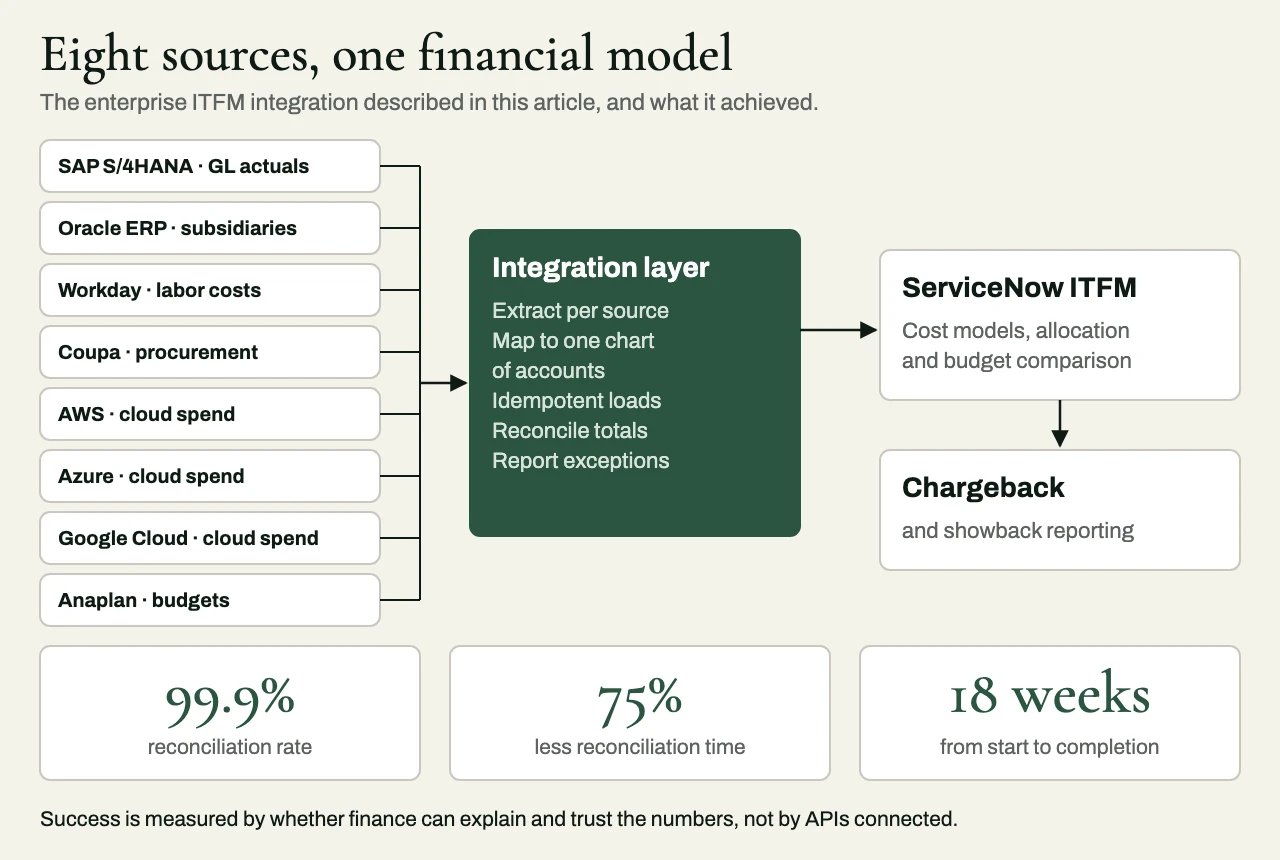
eProxim carried out an enterprise integration engagement that connected financial, workforce, procurement, planning and cloud cost information to a ServiceNow ITFM environment. The project shows why financial integration takes a good deal more than moving records from one application to another.
The Business Problem
The organization ran multiple financial systems across its business units and legal entities, and its IT costs were spread across general ledger accounts, employee costs, vendor contracts, cloud bills and infrastructure services. Finance understood the spending by account, department and legal entity. IT understood it in terms of applications, technology services and infrastructure consumption. What the organization didn’t have was a way to connect those two views.
The CIO needed to know more than how much the business spent on technology. The real question was what particular applications and services cost to run, and which business units consumed them. The organization wanted to know, for example, the fully allocated cost of running its customer onboarding platform; how much of that cost came from infrastructure, software, labor and external vendors; which departments used the service; how actual spending compared with approved budgets; and whether the resulting figures could be reconciled to the corporate general ledger.
ServiceNow was the destination for cost modeling and allocation. The challenge was to build the financial integration layer that would feed it accurate, consistent and auditable information.
The Systems Involved
The engagement involved eight enterprise data sources:
| System | Financial data involved |
|---|---|
| SAP S/4HANA | Corporate GL actuals, journals and cost centers |
| Oracle ERP | Subsidiary financial transactions |
| Workday | Employee, organizational and labor-cost information |
| Coupa | Procurement, supplier, invoice and contract information |
| Amazon Web Services | Cloud consumption and billing |
| Microsoft Azure | Cloud spending at the subscription level |
| Google Cloud | Resource spending at the project level |
| Anaplan | Approved budgets and forecasts |
The goal was never just to consolidate these records. Each source had to be normalized into a consistent financial model, while keeping enough detail to explain where every reported cost came from. So the architecture kept the source-specific extraction and transformation separate from the interfaces facing ServiceNow, which meant that a change to an individual ERP, or to a cloud provider’s billing format, wouldn’t ripple through the entire ITFM implementation.
Challenge 1: Two ERPs, One Financial Model
SAP and Oracle recorded financial activity with different charts of accounts, different cost-center structures and different organizational hierarchies, so an expense classified one way in SAP could be classified quite differently in Oracle. eProxim’s integration layer normalized the source records, and applied controlled mappings between accounts, legal entities, cost centers and IT cost categories.
The important decision was to keep the original financial identifiers alongside their standardized equivalents, so that every transformed record could still be traced to its source ledger, accounting period and extraction batch. The mappings also carried effective dates, because when an organization restructures, changing today’s hierarchy mustn’t silently rewrite last year’s financial history. Records that couldn’t be mapped were treated as exceptions to be reviewed – they were never discarded, and never given an arbitrary default.
Challenge 2: Making Cloud Spending Comparable
Cloud billing is a different kind of problem from general ledger integration. AWS, Azure and Google Cloud each have their own billing structures, resource identifiers, discount models and ways of representing usage, and their bills mix consumption charges, credits, enterprise discounts, committed-use arrangements and prepaid or amortized expenses. None of these figures necessarily lines up with the accounting period, or the amount, recorded in the general ledger.
So the integration had to tell cloud consumption apart from recognized financial expense. A cloud commitment, for instance, may be paid upfront, while its economic cost is spread across the months in which the capacity is actually used. Adding the whole upfront payment to the monthly usage charges would overstate the expense, and ignoring credits and discount allocations would produce an error in the other direction. The normalized dataset allowed cloud spending to be mapped to applications, services and business units, using whatever ownership and configuration information was available – and, crucially, that allocation could still be reconciled to the authoritative financial records.
Challenge 3: Labor and Procurement Costs
Labor is often one of the largest parts of IT spending, and yet payroll information is sensitive, and it doesn’t line up naturally with cost models built around applications. Workday supplied the organizational and labor-cost information, and the integration was designed to deliver the level of aggregation that cost allocation needed, without exposing individual compensation unnecessarily.
Procurement brought a subtler problem. A supplier invoice recorded in Coupa might already be represented in SAP’s general ledger, and importing both as separate expenses would count the same spending twice. The integration had to separate procurement detail, which helps explain costs, from the authoritative accounting actuals, which determine the financial totals. It’s an easy distinction to miss when different teams build the source feeds independently, and missing it inflates spending in a way that’s hard to trace afterwards.
Challenge 4: Proving the Numbers Reconcile
Moving records into ServiceNow was only half the job. The integration also needed controls that would show the financial data had been transferred accurately. So the design dealt with source and destination totals by company, ledger and accounting period; rejected transactions and unmapped accounts; preventing duplicates when jobs were retried; late journal entries and accounting adjustments; restating periods that had already been loaded; audit trails at the batch level, with traceability back to the source records; and exception reports for finance to review.
Think about a monthly load that fails after it has processed most of its records. Simply restarting the job and appending everything again could duplicate a large part of the month’s spending. A properly designed load has to be idempotent instead, so that processing the same batch twice can’t create duplicate financial results, and a journal adjustment entered after month-end has to be absorbed without corrupting or duplicating figures that have already been reported. These controls matter most when the integration supports financial chargeback, as opposed to informational showback. A wrong showback report can mislead management, which is bad enough, but a wrong chargeback journal changes real accounting balances.
The Result
The completed integration provided the data foundation for bringing together IT costs from multiple enterprise sources within ServiceNow’s financial management environment. It achieved a 99.9% reconciliation rate, cut reconciliation time by 75%, and was completed in 18 weeks. It connected financial accounting information with the operational detail needed for IT cost modeling, service allocation, budget comparison and financial reporting.
The real engineering achievement was consistency across systems that didn’t share the same definitions of cost, ownership or reporting period. The engagement reinforces a lesson I would apply to any ITFM program, which is that the measure of success is whether the financial information that comes out at the end can be explained, reconciled and trusted – and the number of APIs connected tells you very little about that.
Integration Patterns in ServiceNow
The right implementation pattern depends on the source system, the volume of data, the integration infrastructure that’s already in place, and the ServiceNow environment itself.
Import sets and transform maps are a practical choice for bulk financial loads. Source records are staged, validated and transformed into the appropriate ServiceNow structures, which makes the approach a good fit for periodic general ledger and budget loads, where repeatability and auditability matter.
A MID Server is the natural answer when the source systems sit inside a private network and shouldn’t be exposed publicly, since it gives ServiceNow a controlled connection to internal databases and services.
IntegrationHub and Flow Designer make sense where supported spokes exist and the requirements fit what they can do. For moderate-volume processes, they can cut down on custom development, although large financial datasets and complicated transformations may justify a separate integration layer.
Scripted REST APIs are useful when source platforms push financial data into ServiceNow, or when external consumers need a controlled, versioned interface. Authentication, validation, throttling, error handling and logging are still essential, however simple the API looks.
External middleware is often the wiser choice for organizations that already run MuleSoft, Boomi or another enterprise integration platform. Reusing established integration services is generally better than rebuilding ERP extraction logic inside ServiceNow, and a shared integration layer brings consistent monitoring, transformation, security and exception handling along with it.
Whichever pattern you choose, the governing principle is to put the transformation and control logic where it can be maintained without creating unnecessary dependencies between systems.
Design Decisions That Make or Break ITFM Integration
Chart of Accounts and Cost-Center Mapping
The first decisions are about which accounts and cost centers are in scope, how they map to IT cost categories, and who owns those mappings. Over time, the mappings have to accommodate new departments, retired accounts, acquisitions and reorganizations. An unmapped account should always produce a visible exception – it should never just quietly drop out of the financial dataset.
Period Close and Restatements
Financial ledgers don’t stand still after the first month-end extraction. Late journals, corrections, reclassifications and reopened periods are all normal accounting activity, and the integration has to support controlled reloads and corrections of a period without producing duplicate amounts.
Data Granularity and Volume
There’s a genuine trade-off between detail and processing cost. Importing every general ledger transaction gives you rich traceability, but it may create volume you don’t need, whereas aggregating by account, cost center, vendor and accounting period is often enough for ITFM reporting, as long as the audit trail at the source level is kept somewhere else. The right choice depends on the allocation requirements, the reporting needs and the data volumes, and it should be tested against a representative historical dataset – a small sample month won’t tell you enough.
Currency Conversion
Multinational organizations have to decide whether ServiceNow receives the transaction currency, the reporting currency or both, and the sources of exchange rates, the conversion dates and the accounting policies should be agreed with finance in advance. Converting the same value in two systems with two different rate tables is an excellent way to spend several days chasing a discrepancy that should never have existed.
Idempotency and Recovery
Every financial load should carry a unique batch identifier, and support safe retries. Integration failures will happen, whatever you do, but duplicate expenses are entirely avoidable. The recovery design has to be in place before production deployment, so that nobody is improvising it during the first failed month-end close.
Reconciliation: The Feature Finance Actually Cares About
Integration teams naturally focus on throughput, latency and error rates. Finance has a more direct concern, which is whether the numbers agree, and that’s why a reconciliation framework should be built in the first phase of the implementation, alongside the interfaces themselves.
At a minimum, the framework should provide control totals that compare source and target figures by company, ledger, accounting period and currency. It should manage exceptions – rejected records, unmapped accounts, invalid references and unusual adjustments – with clear ownership for each. It should keep an audit trail that identifies which batch created or updated a financial record, and traces it back to the system it came from. And it should give finance an intelligible monthly report, showing source totals, loaded amounts and explained differences, for sign-off.
An integration job can succeed technically and still be financially wrong. When the job succeeds, all it tells you is that the software worked. Whether the business can trust what the software produced is a separate question, and the reconciliation is what answers it.
Data Going Out: Chargeback Integration
Inbound data gets most of the attention, but ITFM implementations sometimes need outbound integration as well – to send chargeback journals to an ERP, export allocated IT costs to a corporate data warehouse, return budget variance information to planning tools, or synchronize approved adjustments with corporate financial systems.
Outbound chargeback calls for especially strong controls, because a duplicate posting affects real financial balances. These interfaces should support posting authorization, transaction identifiers, acknowledgment handling, error recovery and duplicate prevention. I would also argue that chargeback should generally come after a period of validated showback reporting, which gives finance and IT the chance to review how accurate the allocations are before the results reach the accounting records.
Common Failure Modes
The same problems come up in financial integration projects with striking regularity. The first is loading the actuals once and never correcting them, when financial records will inevitably change after the first extraction, and the integration has to support updates and restatements. The second is keeping account mappings in an unmanaged spreadsheet, when the mapping logic deserves ownership, version control, review and an audit trail of its own.
Another is trusting incomplete configuration data. If the CMDB doesn’t accurately represent the applications and services, any costs allocated through those relationships will be inaccurate too. Building every integration on its own is a further trap, because separate source-specific logic produces inconsistent transformations and makes maintenance more expensive. Confusing cost detail with accounting actuals – when a procurement invoice and a ledger expense represent the same transaction, and both get imported – inflates spending. And waiting until user acceptance testing to reconcile means discovering the financial discrepancies at the very point where changing the integration architecture and the data model costs the most. Reconciliation belongs in the first working interface.
A Sensible Implementation Sequence
For a new ITFM integration engagement, taking it in phases reduces both the technical and the financial risk.
- General ledger actuals and cost-center hierarchy. Establish the authoritative financial totals and the reconciliation, ideally with a full year of historical data.
- Budget and forecast integration. Normalize the planning information to a granularity that can be compared with actual spending.
- Labor costs. Bring in workforce expense allocations, with the appropriate privacy controls.
- Cloud and procurement spending. Add service-level detail, while making sure the same spending is never recognized twice.
- Outbound chargeback. Introduce financial postings only once the allocation logic and the showback reporting have been validated over multiple periods.
Not every organization needs all five phases. The sequence should reflect the business’s priorities, how ready the source systems are, and how mature the ITFM cost model is.
Related reading
- Integration reconciliation reports: proving that two systems agree
- SAP integration options: IDoc, BAPI, OData or Integration Suite?
Working With eProxim on ServiceNow Integration
eProxim is an integration engineering partner, and we don’t run a general-purpose ServiceNow implementation practice. We work alongside the ServiceNow implementation partners who own the platform configuration, the financial models and the client relationship, and our role is to build the integration layer that connects ServiceNow to the ERP, HR, procurement, planning and cloud platforms it depends on. That work covers enterprise API design, integration architecture, data transformation, financial mapping, reconciliation, batch processing, monitoring and production support.
Our experience with enterprise middleware and complex financial systems lets partners take on integration-heavy ServiceNow engagements without having to build and keep a separate integration engineering team of their own, and we can deliver the work under a partner’s brand, within its architecture and its delivery processes.
Have a ServiceNow ITFM project where the integration work has turned out to be more complicated than expected? Start a partner conversation, or find out how our white-label delivery works.